
Home DIY covers all the work done by an individual without resorting to a craftsman: painting, laying flooring, small carpentry, furniture assembly, or routine repairs. In recent years, DIY trends have evolved due to budgetary and regulatory constraints that change the way projects are prepared and executed.
Hybrid renovation: entrust the technical aspects, keep the finishes
An increasingly common approach is to split a project into two parts. The work related to electricity, gas, plumbing, or structural elements is entrusted to a professional. The finishes (plastering, painting, laying floating floors, installing shelves) remain in the hands of the individual.
This hybrid renovation limits risks related to insurance and safety standards while retaining some of the savings from DIY. The calculation is simple: labor often represents the largest portion of a quote, and finishes are precisely the areas where it is the least technical.
To organize this division, several resources detail projects suitable for each level. Recent feedback and DIY tips are regularly published on the blogdubricoleur.fr site, which helps assess the feasibility of a task before starting.
Reduced VAT on work: what has changed for purchasing materials
The tax rules applicable to construction work were modified on March 1, 2025. The old Cerfa certificates required to benefit from reduced VAT have been eliminated. They are replaced by a mention directly inscribed on the quote or invoice.
This simplification benefits craftsmen, but it has a direct consequence for DIYers: materials purchased directly by the individual generally remain subject to the normal rate. Only the supply and installation billed by the company may fall under a reduced rate, under certain conditions.
In practice, this means that completing an entire renovation project oneself can sometimes cost more in materials than entrusting the supply to the craftsman. For an interior renovation project (insulation, wall covering, tiling), it is worth requesting a quote that includes the supply to compare the overall cost with a separate purchase.
Construction waste sorting: an obligation to integrate from the preparation stage
Since January 1, 2024, source sorting of construction waste concerns mineral waste, wood, plaster, metal, and other waste. This obligation, initially aimed at professionals, has concrete effects on individuals who renovate on their own.
Waste disposal sites now apply stricter sorting upon receipt. Arriving with a mix of rubble, plaster, and wood can lead to refusal or additional costs. Anticipating sorting from the beginning of the project avoids back-and-forth trips and unpleasant surprises.
- Plan for separate containers from day one: one bin for mineral waste (tiling, concrete, bricks), one for wood, one for plaster.
- Check the acceptance conditions of the local waste disposal site before starting work, as the allowed volumes and channels vary from one municipality to another.
- Keep the labels of the products used (paint, glue, solvent): some waste is classified as hazardous and requires specific disposal.

DIY tips for successful finishes without professional equipment
Finishes concentrate the majority of visible errors on an amateur project. A few simple techniques can yield a clean result with basic tools.
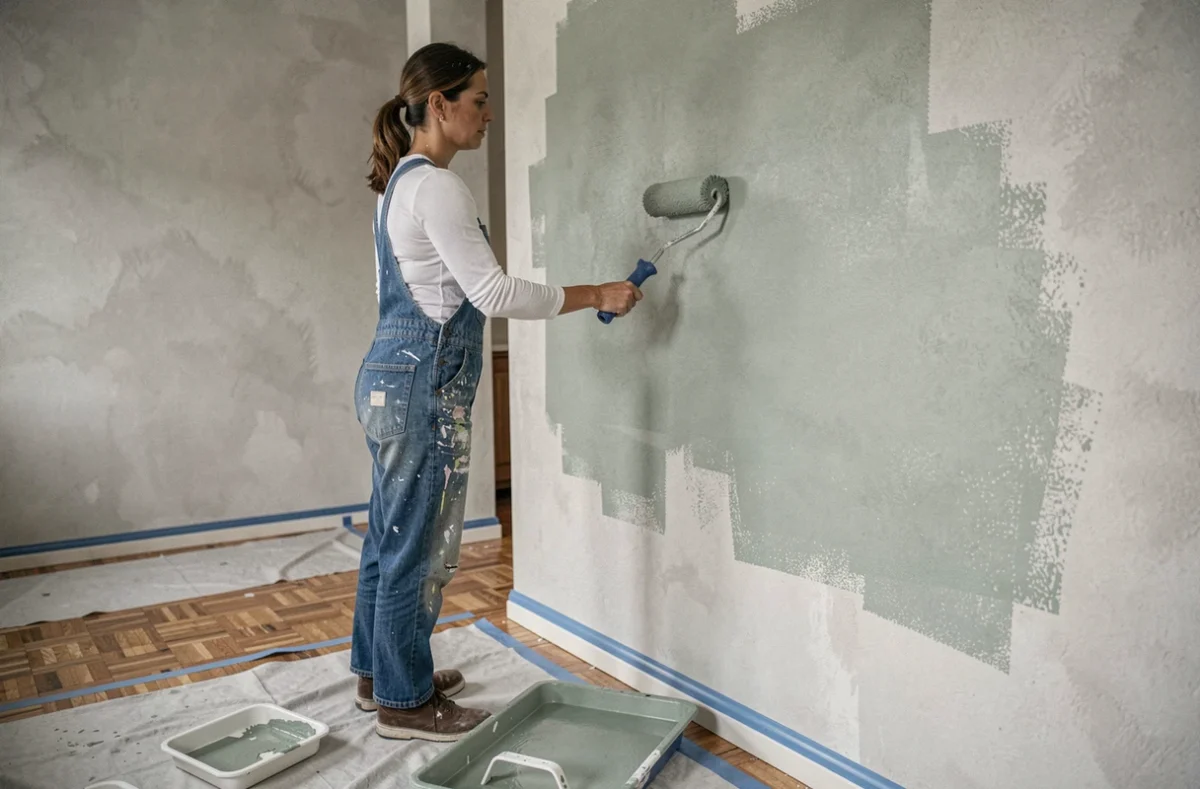
Painting: prepare the surface rather than adding layers
A poorly sanded or dusted wall absorbs paint unevenly. Applying a third coat does not correct the problem; it thickens it. A careful sanding with fine grit followed by a damp wipe provides a more uniform finish than an additional coat.
For corners between wall and ceiling, masking tape applied the day before (and not just before painting) adheres better and limits smudging. Removing it before the last coat is completely dry prevents peeling off the paint.
Laying floating floors: managing edge cuts
Floating floor planks expand with temperature. Leaving a gap of a few millimeters around the edges is a well-known rule, but cutting the last plank to the correct width often poses a problem for beginners.
Mark the cut by placing the plank upside down against the baseboard, marking with a pencil, then cutting with a jigsaw gives a clean cut. The gap will be concealed by the baseboard or a quarter-round.
Home DIY budget: balancing purchases in a declining market
The French market for large DIY stores recorded a decline in value in 2024, followed by another drop in 2025. This contraction pushes brands to rethink their ranges, but it also encourages individuals to fine-tune their spending.
Here are some concrete ideas to reduce the cost of a project without sacrificing quality:
- Favor corded tools for heavy work (sander, drill press): they are cheaper than battery equivalents and deliver consistent power.
- Rent specialized equipment used only once (wallpaper stripper, electric tile cutter, concrete mixer) rather than buying it.
- Buy consumables (screws, plugs, abrasives) in professional packaging. The price per lot is often halved compared to retail blister packaging.
The market decline also has a positive effect for buyers: promotions on end-of-line products are multiplying, and the second-hand market for power tools is expanding.
Successfully completing a DIY project depends less on the number of tools than on the quality of preparation. Identifying tasks to outsource, checking tax implications, anticipating waste sorting, and caring for finishes transform an amateur project into a lasting result. A well-prepared project costs less than a project redone.