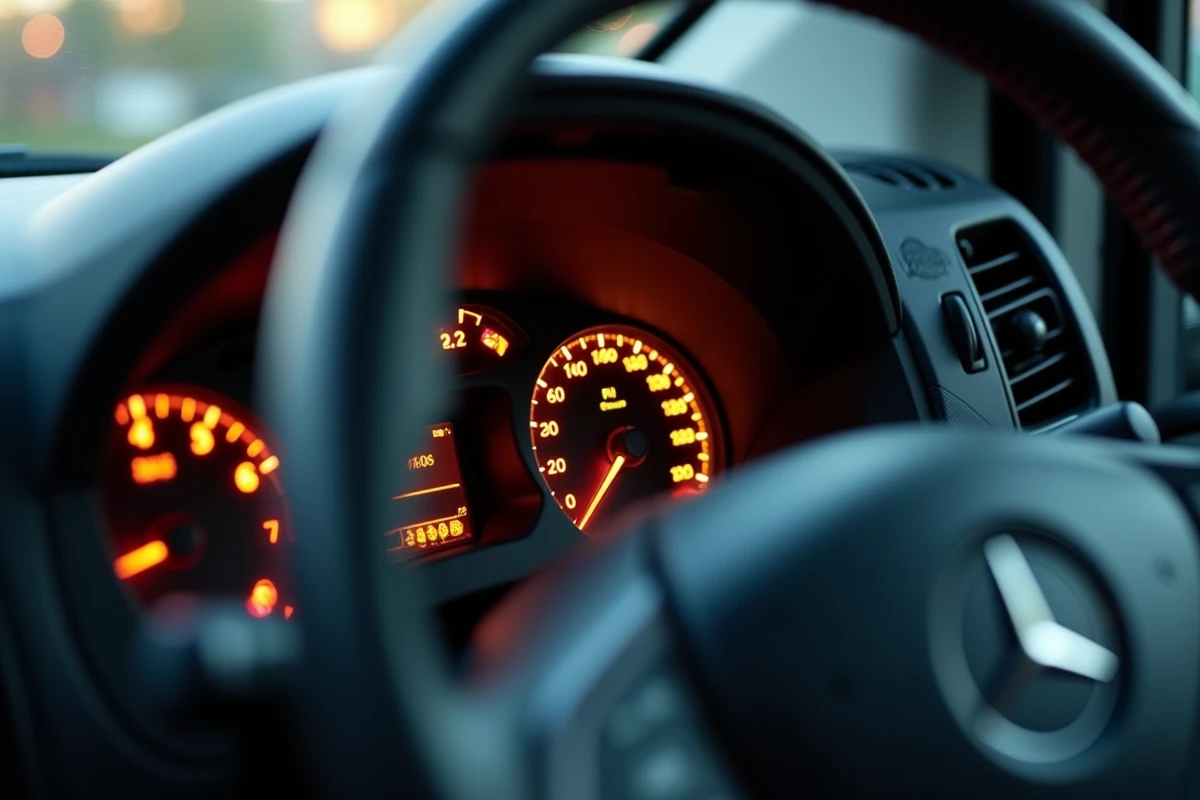
The dashboard of the Mercedes Vito features a notable number of orange warning lights, the meaning of which varies depending on the generation (W638, W639, W447) and the type of engine. Confusing a diesel preheating light with an engine fault managed by the ECU, or ignoring a power steering icon, leads to incorrect diagnostics and unnecessary interventions.
Power Steering Light on Mercedes Vito: An Underestimated Fault in the Workshop
The icon of a steering wheel with an orange exclamation point indicates a total or partial loss of power steering assistance. On W447 Vitos equipped with an electro-hydraulic power steering pump, this light comes on while driving when the electric pump no longer provides the expected pressure.
Related reading : The Precious Medal: A Symbol of Elegance and History
The identified causes in the workshop include a faulty steering angle sensor, a drop in power supply voltage to the pump, or a mechanical failure of the pump itself. This light requires an immediate adjustment in driving: the effort on the steering wheel increases significantly, road handling deteriorates, and the safety distance must be increased.
We recommend not to continue a long journey with this light on. A diagnosis via the OBD port allows for a quick distinction between an electrical problem (voltage, fuse, wiring) and a mechanical problem (pump, rack).
Further reading : Guillaume Faury and his wife: truths, confessions, and the end of rumors
Orange Engine Light and DPF Clogging on Diesel Vito
The orange engine light (check engine) is the most common on diesel Vitos used in the city or for short trips. We observe that the primary cause of activation remains the clogging of the particulate filter. The regeneration cycles of the DPF require a high exhaust temperature, achieved only during prolonged driving at high RPM.
On a Vito assigned to urban deliveries, the DPF accumulates soot without ever regenerating properly. The first signs are an orange engine light accompanied by a slight loss of power. This scenario directs the diagnosis towards a soot and clogging issue, not towards an isolated sensor failure or an ignition problem.
Consulting the list of orange warning lights on Mercedes Vito helps distinguish this engine light from other similar icons like that of preheating or the pollution control system.
Forced Regeneration and Limits of the Procedure
Forced regeneration via diagnostic tool (Star Diagnosis or equivalent) remains the first intervention attempted. It involves initiating a soot combustion cycle while stationary, with the engine running at a calibrated RPM set by the ECU.
This procedure has its limits. If the soot level exceeds a critical threshold recorded by the ECU, the forced regeneration fails, and replacing the DPF becomes the only option. A precise OBD diagnosis avoids replacing a filter that is still recoverable.
ESP and ABS Light on Vito: Shared Causes, Distinct Diagnosis
The orange ESP light (triangle with tire tracks) and the ABS light often illuminate simultaneously on Vitos, which suggests a serious fault in the braking system. In practice, the most common cause is a faulty or dirty wheel speed sensor.
The wheel sensors on the Vito are exposed to splashes, mud, and salt. A sensor with erratic signals first triggers the ABS light, and then, through a software cascade, disables the ESP. The onboard system then displays both lights simultaneously.
- Dirty or cut wheel speed sensor: the most frequent cause, verifiable with a multimeter or OBD tool
- Fault in the ABS hydraulic module: rarer, identifiable by specific fault codes (C0XXX on Star Diagnosis)
- Wiring issue between sensor and ECU: common on high-mileage Vitos, corrosion of connectors under the chassis
The critical point: an ESP light alone, without ABS, points to a fault in the steering angle sensor or yaw sensor, not a braking issue. The distinction between these two scenarios completely changes the diagnosis and the cost of the intervention.

High Voltage Battery Light on Electric Vito: Do Not Confuse with 12 V
On electric Mercedes Vitos (eVito), an orange light representing a battery with a reserve bar indicates that the high voltage battery charge has reached the reserve zone. This light does not signal a fault with the 12 V auxiliary battery, which has its own icon.
Confusing the two leads to errors in handling: a standard mechanical check (alternator test, 12 V battery test) will not resolve anything if the light concerns high voltage. The solution is a quick recharge, not a trip to the workshop.
12 V Auxiliary Battery and Associated Light
The classic 12 V battery light (red or orange icon depending on severity) remains present on eVitos. It lights up when the voltage of the auxiliary battery drops below the operational threshold for onboard systems. On an electric vehicle, this 12 V battery powers accessories (lighting, dashboard, locking) but not traction.
A charging fault of the 12 V on eVito often comes from the DC-DC converter that transforms high voltage into 12 V. This component, absent from thermal Vitos, adds a layer of specific diagnostics for electric versions.
Reading the Orange Lights on the Vito with an Appropriate Diagnostic Tool
The onboard system of the Vito provides text messages associated with the lights on W447 versions equipped with the MBUX system or multifunction display. These messages specify the nature of the fault, but their wording remains vague (“Engine fault – Consult workshop”).
- A generic OBD tool reads engine fault codes (PXXXX) but does not cover specific Mercedes body or chassis codes
- Star Diagnosis (or Xentry) accesses all the ECUs of the Vito, including ESP, power steering, and high voltage battery
- Intermediate tools (iCarsoft MB, Autel) cover the majority of codes but sometimes miss recent subsystems
We recommend always noting the exact fault code before any intervention. An orange light without an recorded fault code may indicate a loose connection or an intermittent wiring problem, not a component failure.
The diagnosis of the Vito becomes more complex with each generation. On recent models, the same orange light can correspond to several dozen different fault codes. Noting the code before ordering a part remains the basic rule to avoid unnecessary replacements.